



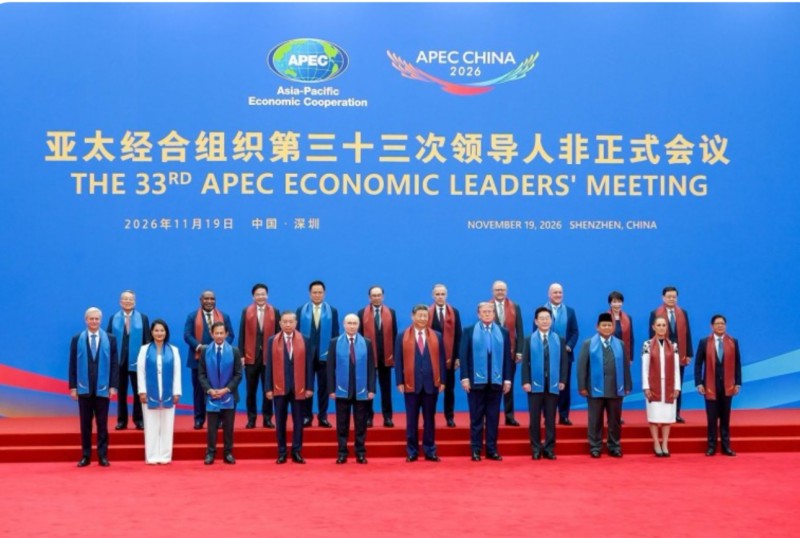
Commerce Wire, Shenzhen, November 19 — The 33rd APEC Economic Leaders’ Meeting wrapped up in Shenzhen, Guangdong Province, on November 19. Centered on the theme Building an Asia‑Pacific Community for Common Prosperity, the meeting unanimously endorsed the 2026 APEC Economic Leaders’ Declaration, featuring the landmark outcome document the Shenzhen Vision for building an Asia‑Pacific Community, alongside three supporting outcome documents covering trade, connectivity and innovation.
This marks China’s third time hosting APEC, following the 2001 Shanghai meeting and the 2014 Beijing gathering. It is also the first APEC Economic Leaders’ Meeting held in China in 12 years. President Xi Jinping of China presided over the session. According to the Foreign Ministry, in his remarks, President Xi elaborated on China’s vision for what kind of Asia‑Pacific Community to build and how to build it, calling for fostering an Asia‑Pacific community featuring solidarity and mutual assistance, openness and integration, enterprise and innovation, as well as inclusive development.
The Shenzhen Vision establishes the “Four Beams and Eight Pillars” cooperation framework
According to Foreign Minister Wang Yi at the post‑meeting press briefing, the Shenzhen Vision delivers major advances for building the Asia‑Pacific Community across six dimensions, anchored by the cooperation framework known as the “Four Beams and Eight Pillars”.
The Four Beams refer to four core cooperation pillars: economy and trade, connectivity, innovation, and development. The Eight Pillars cover concrete priority areas: the Free Trade Area of the Asia‑Pacific (FTAAP), hard infrastructure connectivity, regulatory soft connectivity, people‑to‑people bonds, digital economy, emerging technologies, capacity‑building, and sustainable growth. The framework translates the vision of an Asia‑Pacific Community into an actionable roadmap.
On trade, the meeting adopted the APEC Framework for Trade Digitalization Cooperation and issued the Statement on the FTAAP Agenda, re‑energizing the FTAAP process. This year marks the 20th anniversary of the FTAAP vision; China has galvanized consensus among members to inject fresh momentum into this long‑term goal. On connectivity, an upgraded APEC Connectivity Blueprint was agreed upon, spanning physical infrastructure, supply‑chain links, regulatory coordination and travel facilitation. On innovation, leaders endorsed the APEC Statement on Emerging Technologies for Employment and Prosperity, reaching consensus on leveraging emerging technologies including artificial intelligence to boost jobs and public services.
Historic “Shenzhen Initiative” released at the APEC CEO Summit
As a key component of Leaders’ Week, the 2026 APEC CEO Summit convened from November 17 to 18 ahead of the leaders’ meeting. More than 2,000 political and business representatives from 21 APEC economies and 13 non‑APEC economies took part. The summit issued the 2026 APEC CEO Summit Shenzhen Initiative. It is the first‑ever outcome released in the form of an “initiative” in the summit’s 30‑year history, designed to deliver a practical, follow‑up‑ready collective action framework for Asia‑Pacific business cooperation.
China announces a package of voluntary measures
President Xi Jinping unveiled new Chinese measures in support of Asia‑Pacific cooperation during the meeting. These include financial backing for APEC practical cooperation, setting up the Center for Asia‑Pacific Community Studiesin Shenzhen, and establishing new cooperation institutions for digital technologies, cross‑border data flows, clean energy and small‑ and medium‑sized enterprise (SME) development. As specified by Minister Wang Yi, China will provide USD 20 million to fund APEC practical cooperation projects.
Shenzhen: from opening‑up gateway to innovation exemplar
Hosting the meeting in Shenzhen carries strong symbolic meaning. Growing from a special economic zone, the “city of innovation” stands as a real‑world example of how openness and innovation reinforce one another. Analysts note thematic continuity across China’s three APEC hostings: New Century, New Challenges (Shanghai, 2001), Building an Asia‑Pacific Partnership for the Future (Beijing, 2014), and Building an Asia‑Pacific Community for Common Prosperity (Shenzhen, 2026). Selecting Shenzhen underscores innovation‑driven growth as a core priority on the current APEC agenda.
During the meeting week, President Xi Jinping conducted nearly 20 bilateral and multilateral engagements, including chairing the China‑Russia‑US trilateral leaders’ meeting. Information on the host for the next APEC Economic Leaders’ Meeting is not specified in available materials.