



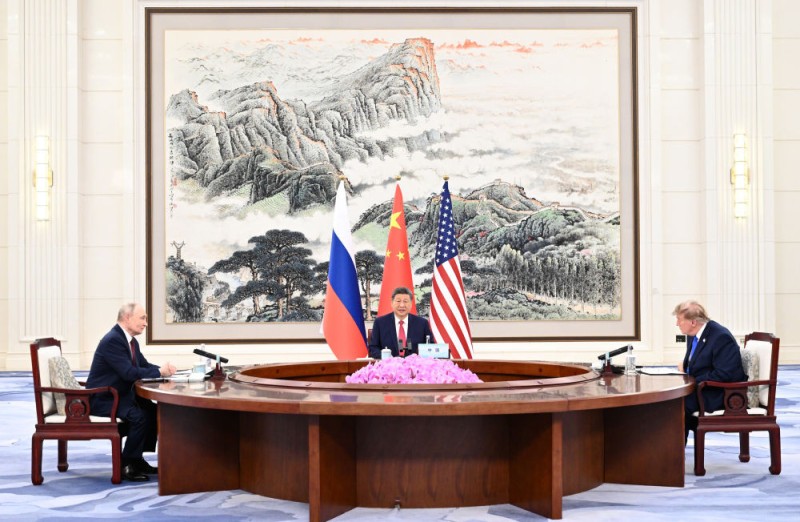
Commerce Wire, Shenzhen, November 19 — Highlight of the 33rd APEC Economic Leaders’ Meeting week, President Xi Jinping of China, President Vladimir Putin of Russia and President Donald Trump of the United States convened a trilateral face-to-face summit in Shenzhen on November 19. This marks the first-ever in-person meeting of the three heads of state. A China-Russia-US Leaders’ Peace Declaration was issued after the talks, centred on safeguarding global peace and advancing strategic stability among major powers.
Historic Gathering: First Face-to-Face Trilateral Leaders’ Meeting
Mao Ning, Foreign Ministry Spokesperson, characterised the meeting as “groundbreaking” in her pre-summit press briefing. She noted that China, Russia and the United States are all founding members and permanent members of the UN Security Council. The three nations fought side by side to win the World Anti-Fascist War. Under current circumstances, they bear important responsibilities to jointly tackle global challenges and uphold world peace and stability.
The summit convened on the afternoon of November 19 in Shenzhen. The Russian and US leaders thanked China for hosting this historic encounter. According to Foreign Minister Wang Yi at the post-summit press conference, discussions were candid, amicable and constructive. The three presidents exchanged in-depth views on critical issues bearing on global peace, security and stability and reached a package of consensus.
Wang Yi described the event as a “peace summit” of far-reaching, landmark significance that will be etched in history. He stressed that this first-ever face-to-face trilateral meeting opens a new chapter in high-level engagement among the three countries and establishes a new paradigm for major-power coordination and interaction in the new era.
Four Consensus Points in the Peace Declaration
The China-Russia-US Leaders’ Peace Declaration released after the meeting sets out four core understandings:
- UN Reform: As permanent Security Council members, the three countries commit to advancing UN reform so the organisation can respond more effectively to global challenges and fulfil its fundamental mandate of maintaining international peace and security.
- Energy Stability: The three sides plan to boost production and supply of refined oil products and reaffirm the importance of stable energy flows.
- Jurisdiction of the International Criminal Court: The leaders recognised the vital importance of the principle of state consent and immunity for state officials. They agreed that the ICC and comparable bodies must not abuse their jurisdiction.
- Nuclear Risk Control: The three sides reiterated that “a nuclear war cannot be won and must never be fought”, and agreed to hold dialogues on mitigating nuclear risks and preventing nuclear proliferation.
Xi Jinping Elaborates on Principles for Major-Power Relations
During the talks, President Xi emphasised: “When major powers live in harmony, the world enjoys peace; when major powers are in confrontation, the world descends into turmoil.” As relayed by Wang Yi, the three leaders clarified their respective strategic intentions face-to-face. They expressed readiness to avoid conflict and confrontation, hold the bottom line of peaceful coexistence, and work toward a new framework of major-power relations featuring peaceful coexistence, overall stability and balanced development.
President Xi stated that China consistently advocates equality of all nations, advances democratisation of international relations, and pursues an equitable and orderly multipolar world. Major powers, with greater resources and capacity, should demonstrate vision and responsibility, taking the lead internationally in upholding equality, good faith, morality and cooperation.
Bilateral Meetings Lay Groundwork; China-US Set New Relational Framework
Prior to the trilateral summit, President Xi held separate bilateral meetings with Putin and Trump between November 18 and 19 to pave the way for the three-way talks.
China-Russia: In his meeting with Putin on the 18th, President Xi noted that this year marks the 30th anniversary of the China-Russia comprehensive strategic cooperative partnership and the 25th anniversary of the Treaty of Good-Neighbourliness and Friendly Cooperation. China-Russia relations “stand firm amid storms”, bringing greater stability and certainty to a turbulent world.
China-US: In his meeting with Trump on the 19th, President Xi said the two sides had established the new positioning of a “constructive strategic stable relationship” in recent months, defined by the spirit of “mutual respect, fairness and reciprocity”. He underscored that the United States must do the right thing on the Taiwan question to prevent major setbacks in bilateral ties. Trump stated that the United States does not support “Taiwan independence”. The two sides agreed to formulate an action plan for this constructive strategic stable relationship to implement the consensus reached by the two heads of state.
Context and Strategic Implications
By bringing security and geopolitical topics into the APEC agenda, which centres primarily on trade and economy, the summit sends a clear signal: Asia-Pacific economic integration and open cooperation cannot proceed without fundamental strategic coordination and stable ties among key major powers. Held on the closing day of the APEC meeting, this first trilateral leaders’ encounter and the release of the Peace Declaration add strategic weight beyond the economic agenda of the Shenzhen gathering.
Wang Yi told reporters that China will fully and efficiently follow through on the consensus with Russia and the United States and maintain working-level communication and coordination. “The seeds sown today will surely take root, sprout, bloom and bear fruit.”